

Rob Cartwright of Skentel explains how remote sensors take meter readings and repetitive site checks off a park team's hands, and how to find the cause of EV charging faults.
Holiday park IoT monitoring might not sound like the most gripping topic. Remote monitoring. Sensors. Data. Battery-powered devices stuck to electric meters.
On this page
And then Rob Cartwright describes a park in Cornwall where the maintenance team moved the shop fridge every month just to reach the meter cupboard behind it. Peak season, during changeovers, the job got skipped. Data was wrong. Nobody knew what they were actually using. Rob’s team turned up, stuck a small device on the meter, and said: you can close the door. The meter now sends a reading every 30 minutes. No one moves the fridge again.
That is, in miniature, what skentel does. Rob has been designing and manufacturing electrical automation systems for 25 years. Sixteen years ago, driving 50,000 miles a year to get eyes on equipment across the UK, he started asking why he couldn’t just connect to it remotely. That question became skentel.
The technology at the heart of it is LoRaWAN, a long-range, low-power wireless protocol that works across large outdoor sites without needing anything wired or powered at the sensor end. Holiday park Wi-Fi is good now, but it is designed for guests streaming video in lodges, not for getting data out of a pool plant room, a touring pitch hook-up, or a borehole. skentel’s devices work where Wi-Fi doesn’t reach, on battery power, for years at a time.
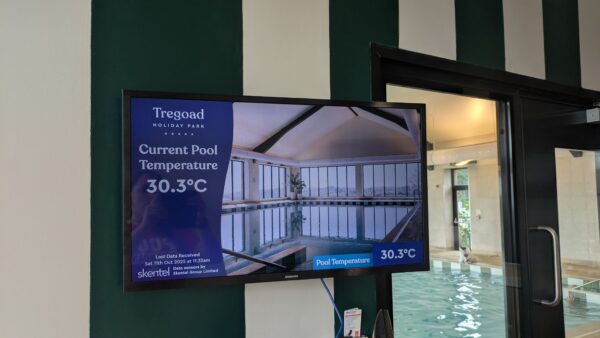
The episode moves through concrete examples from recent site visits. A touring park in Cornwall told it had no electrical capacity left, tripping fuses every time a guest arrived with an EV, where skentel’s monitoring revealed the problem was specific and fixable rather than fundamental. People counting across pools and bars, feeding live occupancy into a green-amber-red view that connects through to the Holidaymaker app so guests can see when it’s quiet and when it’s rammed. A shower block fault detected and a work order raised automatically through SnapFix before any guest noticed the water going cold.
The conversation around integrations is worth listening to carefully. skentel connects with Booking Experts, ParcVu, SnapFix and CoreVision, and feeds data through to the Holidaymaker platform. When a guest checks in, skentel knows. The hot tub heating switches on. The app shows pool temperature. Golf course footfall is visible in real time. The operational layer and the guest-facing layer are starting to share the same data.
The final part of the conversation goes somewhere less immediately operational and more interesting for it. Rob is midway through a 10-year journey to make skentel a circular economy business, with B Corp certification as a milestone along the way.
The contradiction he identified is a good one. A company helping parks monitor and reduce energy use, while buying hardware from overseas, fitting lithium batteries, and selling devices to clients who have no idea what to do with them at end of life, is not a circular business. So skentel is now designing and manufacturing its own hardware at their facility in Bodmin, moving to a service model where they retain ownership and bring devices back for repair, reuse or recycling. They have changed suppliers, changed banks, and restructured how they work.
Rob is honest that it has been expensive and hard. But he is looking at his kids and the generation of guests and operators coming through, and he feels like it matters. There will be a follow-up episode!
Send us a question about remote monitoring, or tell us about your own story if you would like to join us on a podcast. We will get back to you or point you to the right person.
Ask us a question
Remote monitoring and control for holiday parks and leisure estates
Read more

Flood Technology Group found around 30 per cent of UK parks are at risk of flooding. Here is what the numbers show and the first steps parks can take.
Read more

Get benchmarks for your booking journey. James Bouldin of ParcVu shares the abandonment rate he quotes, why stays are getting shorter, and why he favours joined-up tools over one platform.
Read more